Fujifilm XE-5

The camera industry has a habit of chasing itself. Every year, sensors get sharper, autofocus gets smarter, and spec sheets stretch further into territory most people will never fully use. And yet, somewhere along the way, a lot of cameras stopped being fun.
The Fujifilm X-E5 doesn’t try to fix that problem loudly. It just quietly sidesteps it.
This is not a camera designed to dominate benchmarks or overwhelm you with capability. It is a camera designed to be picked up, used, and—more importantly—enjoyed. And in 2025, that idea landed hard enough that the X-E5 didn’t just gain popularity among enthusiasts, it picked up major industry recognition, including awards like Best Enthusiast Mirrorless. Not because it’s the most powerful, but because it’s one of the most thoughtful.
Design that feels intentional again
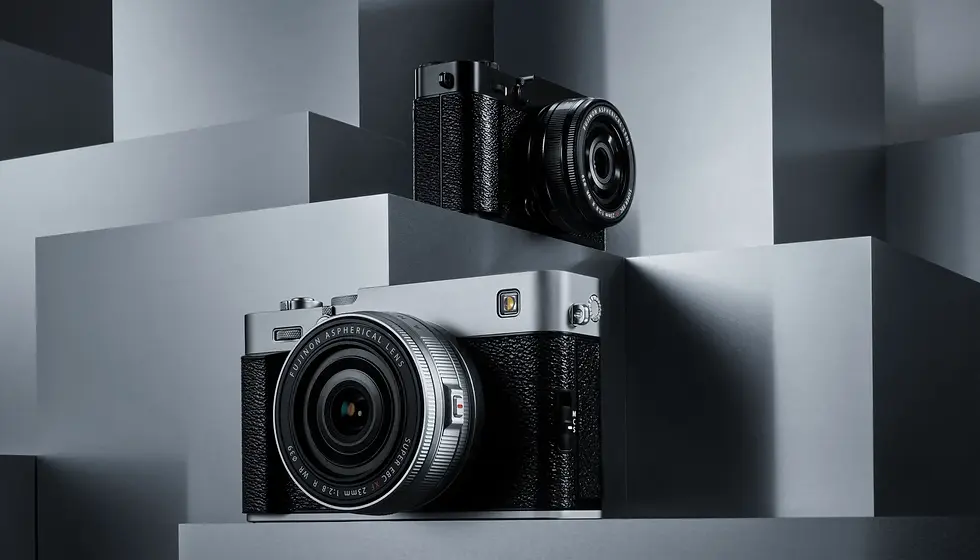
At a glance, the X-E5 looks like a continuation of a familiar idea: compact body, rangefinder-style layout, understated design. But that first impression hides a deeper shift.
After the minimalist experiment of the X-E4, Fujifilm has clearly listened. The X-E5 brings back a sense of physicality that had been missing. The top plate is machined aluminum, cool to the touch, with a density that gives the camera presence without making it heavy. The dials click with purpose. Nothing feels accidental.

※hen there’s the film simulation dial—arguably the most “Fujifilm” addition in years. It includes a small window that physically displays the selected profile, even when the camera is powered off. It sounds like a novelty, but in practice, it subtly changes your workflow. Instead of thinking of color as something you’ll fix later, you make a decision upfront.
That one shift transforms the camera from a capture device into something closer to a creative tool.
The rangefinder-style electronic viewfinder remains offset to the side, and while it’s not the most advanced EVF on the market, it reinforces the way this camera wants to be used. You’re not centered, not fully immersed—you’re observing. It’s a small psychological difference, but it changes how you frame and anticipate moments.
Flagship imaging, deliberately restrained
If the exterior is about simplicity, the interior is anything but.
The X-E5 is built around Fujifilm’s latest imaging core: a 40.2-megapixel X-Trans CMOS 5 HR sensor paired with the X-Processor 5. This is not entry-level hardware. This is the same platform that powers some of Fujifilm’s most capable cameras.
And it shows.
Images are detailed without feeling clinical. Dynamic range is strong, especially in highlights, where Fujifilm continues to excel. Colors are not just accurate—they’re expressive. Skin tones feel natural. Greens don’t scream. Reds don’t bleed. There’s a subtlety to the rendering that makes JPEGs usable straight out of the camera, which is increasingly rare.
The addition of 5-axis in-body image stabilization—something the X-E line has never had before—is a quiet but significant upgrade. It opens up low-light shooting, handheld photography, and slower shutter speeds in ways that dramatically expand what this camera can do, without changing how it feels to use.
Autofocus has also taken a step forward. With AI-assisted subject detection, improved face and eye tracking, and more reliable performance in varied conditions, the X-E5 is firmly modern. But importantly, it doesn’t feel like it’s taking control away from you. It assists, rather than dictates.
That balance is intentional.
Burst shooting reaches up to 20 frames per second electronically, and video capabilities stretch to 6.2K recording with respectable codec options. On paper, those are impressive numbers. In practice, they feel almost secondary. The X-E5 can do these things, but it doesn’t push you toward them.
It’s a stills-first camera in a world that increasingly isn’t.
The X100VI philosophy, expanded
It’s impossible to talk about the X-E5 without acknowledging the influence of the Fujifilm X100VI.
That camera exploded in popularity for a reason. It offered a focused, tactile shooting experience paired with exceptional image quality. But it came with a limitation: a fixed lens.
The X-E5 takes that same philosophy and removes the constraint.
With access to the entire X-mount lens ecosystem, the camera becomes far more flexible. Pair it with a compact 23mm lens, and you essentially recreate the X100VI experience.
Switch to a fast 35mm, and it becomes a portrait tool. Go wider, go tighter—it adapts.
This is where the X-E5 becomes more than just a niche camera. It becomes a platform for a certain style of photography.
Film simulations as a way of thinking
Fujifilm’s film simulations have been around for years, but on the X-E5, they feel more central than ever.
Profiles like Classic Chrome, Velvia, Astia, and newer additions such as Nostalgic Negative aren’t just aesthetic choices—they’re creative directions. Each one shapes how you see a scene before you even press the shutter.
And because of the physical dial, they’re always present. Always visible. Always part of the process.
You don’t shoot everything in neutral and decide later. You commit in the moment.
That commitment changes behavior. It slows you down. It makes you consider light, color, and composition more carefully. It makes photography feel less like data collection and more like decision-making.
The compromises that define it
For all its strengths, the X-E5 is not trying to be perfect—and that comes with trade-offs.
There’s no weather sealing, which limits its use in harsher conditions. The single SD card slot may concern more cautious shooters. Battery life is adequate but not exceptional, often hovering around a few hundred shots depending on usage. The electronic viewfinder, while functional, doesn’t match the resolution or immersion of higher-end models.
And then there’s the price.
At around $1,600 to $1,700 depending on the market, the X-E5 sits firmly in enthusiast territory—significantly higher than previous X-E models. That shift changes expectations. It’s no longer an accessible entry point; it’s a deliberate purchase.
But that’s also the point.
This is not a camera you stumble into. It’s one you choose.
Why it resonated—and why it won
In a year defined by technical escalation, the X-E5 stood out by doing something different. It refined rather than reinvented. It prioritized experience over expansion.
That approach earned it industry recognition, including major imaging awards, but more importantly, it earned something harder to quantify: genuine enthusiasm from photographers.
Not because it could do everything, but because it made people want to shoot.
That distinction matters.
The verdict
The Fujifilm X-E5 is not the most powerful camera of 2025. It is not the fastest, the toughest, or the most versatile.
But it might be one of the most considered.
It takes flagship imaging technology and wraps it in a design that encourages restraint instead of excess. It gives you tools, not automation. It asks for your attention, and rewards it when you give it.
In a landscape full of cameras that try to do more, the X-E5 succeeds by asking you to do less—but better.
Rating: 4.5 / 5
The X-E5 delivers exceptional image quality, thoughtful design, and one of the most engaging shooting experiences in its class. It’s held back slightly by battery life, lack of weather sealing, and a higher price point, but none of those diminish what it does uniquely well.
It doesn’t just capture images.
It changes how you take them.


Nice images